3 minutes
The user interface, written once
The user interface of Coaster Studio is not written per host. It is C++ in the core, like everything else, and every host shows the same one. Not a rebuilt copy, the same components and the same stylesheets.
Here is the same toolbar, once in Unreal Engine 5 and once in the Filament build:
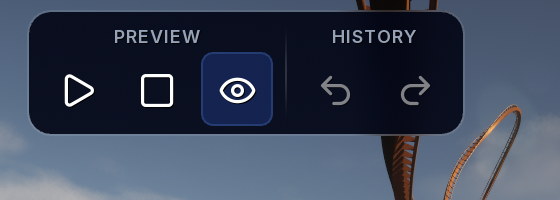
Unreal Engine 5
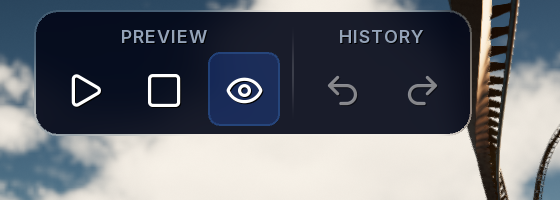
Google Filament
Same padding, same radius, same blur behind the panel, same icons. Nobody keeps those two in sync, they cannot drift apart, because there is only one of them.
How it is built
The interface is written with cppreact, the same library that carries the scene, and it is drawn by RmlUi. So RmlUi is a host as well, just for the user interface instead of the scene: cppreact says what should be there, RmlUi turns it into a document on screen.
A component looks the way you would expect:
struct ButtonProps {
  ButtonVariant variant = ButtonVariant::Default;
  bool disabled = false;
  EventCallback on_click{};
  Children children{};
};
atoms::Button({
    .on_click = bump,
    .children = {"Apply"},
})
What a button looks like is not decided in C++. C++ carries the state, the look lives in stylesheets, in RCSS, which is close enough to CSS that you can read it without learning anything new:
.button {
	line-height: var(--control-height);
	padding: 0dp var(--space-lg);
	border: var(--border-width) var(--border-transparent);
	border-radius: var(--radius-md);
	transition: background-color border-color var(--animation-md-out);
}

.button-default { background-color: var(--primary); border-color: var(--primary-border); }
.button-default:hover { background-color: var(--primary-hover); }
Every size and every color is a token, and all tokens live in one theme file. Sizes are in dp, so
the whole interface scales with the display, which is the reason a retina Mac and a normal monitor
show the same thing at the right size.
RmlUi fixes
If you use a library this hard, you find bugs. I fixed them when I ran into them and keep them as patch files next to the vendored sources, so every build gets them:
- corner radii were wrong
- transitions never worked with
var() - flex layout was slow
- text in transformed elements was blurry
My favourite one: text had the wrong size on Unreal Engine 5 and the right size on the web. On a
display scale change RmlUi refreshes by unit, and a dp inside a var() was never resolved again.
My fix worked and still ate the frame rate, so I closed my own pull request and solved it
differently.
There is no Unreal Engine 5 backend for RmlUi
RmlUi ships backends for OpenGL, Vulkan and DirectX, but none for Unreal Engine 5, so I had to write one. A backend takes the geometry RmlUi produces and puts it on the screen.
I started on Slate, the widget system Unreal Engine uses for its own editor, because I knew almost nothing about RHI back then. But Slate only composes what is already drawn, no render targets, no shader filters, and the frosted glass behind my panels needs exactly that: take what is behind the window, blur it, draw the panel on top.
So the user interface has its own RHI backend now, RHI being the layer right above Metal, Vulkan and D3D. It draws after the tone mapping into the same image as the scene, with blur, gradients, clip masks and MSAA, and it is significantly less code than the Slate path.
At some point I will probably release that part as open source. And I will probably get hate on Reddit again, because how dare I bring web principles into C++.
How the scene side of the same idea works is in one core, two and a half engines.